
Mental Health Moment: Grief’s Effect on our Minds and Bodies
Intense Grief Disrupts Normal Functioning
After your baby went to heaven, did you feel like you were going crazy…like your brain and body were going haywire and reacting unpredictably?
Maybe some of these symptoms ring true:
- Feeling numb or frozen
- Trouble with concentration or memory
- Having angry outbursts or sudden tears
- Compulsively cleaning or organizing
- Feeling separated from your body or detached from your life
- Mentally replaying scenes of the loss over and over during the day or in dreams
- Trouble initiating or completing even the smallest task at home, school, or work
- Dizziness, racing heart, tight chest, upset stomach, or loss of appetite
What if I told you all of these reactions (plus many others) are normal. You aren’t actually going crazy.
You are responding normally to something that is not normal.
Consider this: our English word “crazy” comes from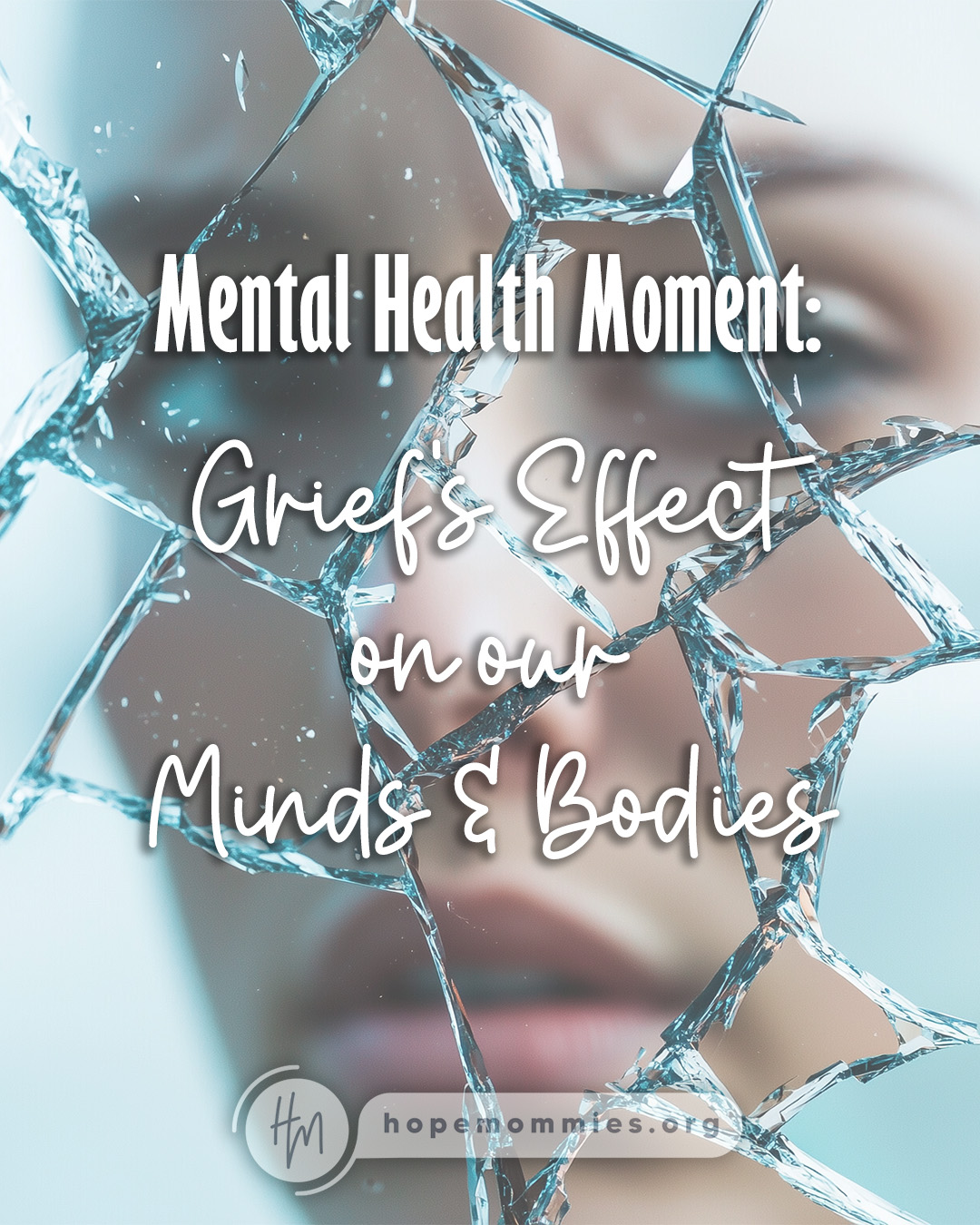 the 14th-century Germanic word crasen, which meant “to shatter, crush, break into pieces.”
Isn’t that what has happened to us? We have been shattered, crushed, and broken into pieces by a devastating loss, a traumatic event.
The Nature of Trauma
To understand the burden our minds and bodies are carrying, we need to acknowledge the nature of trauma. Put simply, trauma is any break in normal functioning.
First, think about trauma to the body. Physical trauma occurs when our healthy flesh is broken, cut, crushed, or torn. The smallest paper cut is a minor trauma to our skin that the body is able to heal by itself. But a larger gash that cannot close on its own needs the skilled hands of a surgeon to stitch it back together.
Using this example to consider psychological trauma, we see a small psychological trauma (like arriving late to an important meeting or getting a speeding ticket) is unpleasant and could take a while for our brains to adjust and respond; but our minds generally know how to handle these circumstances and can recover relatively quickly.
On the other hand, major psychological trauma is an overwhelming wound to our minds. Although our brain attempts to process what happened, this type of trauma severely overloads its capacity to comprehend the event, and fractures its usual way of functioning. We need the help of another to heal.
Death is an enormous trauma to our brain
When the major trauma at hand is death, especially a death that was unexpected, our brains are literally stunned and normal processing is interrupted. This shock response occurs for two reasons.
First, a biological chain reaction is initiated throughout our entire body: our brain’s fear center (the amygdala) triggers a surge of stress hormones which can cause a wide array of the “crazy” grief symptoms (e.g. anxiety, brain fog, fatigue, dissociation and difficulty concentrating).
Second, the concept of death is unfathomable to us because God has put eternity into man’s heart (Ecc 3:11). We were meant to live forever. When we encounter death, we don’t have a way to comprehend it, and were never meant to.
Every Hope Mom has known death’s traumatic power, no matter the circumstances or length of pregnancy. Whether it was at the first signs of miscarriage, the silent scan, the silent delivery, or the silent crib, it’s still trauma because it’s still death.
Our Hope in the Chaos
Although we must endure loss as well as our chaotic responses to death, there is some good news for your traumatized, shocked, weary self.
First, a hint is found in the Greek word for trauma (traûma) which literally means “to wound, pierce.”
But he was pierced for our transgressions, he was crushed for our iniquities; the punishment that brought us peace was on him, and by his wounds we are healed. Isa 53:5
Do you see it? This verse is referring to Jesus, who knows our pain and internal chaos:
– He witnessed the death of people, some very close to him (Mt 14:1-13; Lk 7:11-17; Jn 11:1-37)
– He suffered emotional and physical agony while preparing for his own death (Luke 22:39-46)
– He was traumatically wounded and pierced Himself on the Cross (Jn 19:16-37)
Our Savior was crushed under the wounds of sin and his body was broken by piercing. He intimately knows the trauma of death. We are not alone in our experience of grief.
Second, Jesus was also victorious over death which means He has made a way through it, winning for us a bright hope that can never fade or snatched from us (1 Pet 1:3-5).
Surely there is a future, and your hope will not be cut off. (Prov 23:18)
Third, as we hope for a future life with him (and our babies), but we also anticipate his healing on our earthly bodies today.
…to be renewed in the spirit of your minds, and to put on the new self, created after the likeness of God in true righteousness and holiness. (Eph 3:23-24)
He himself bore our sins in his body on the tree, that we might die to sin and live to righteousness. By his wounds you have been healed. (1 Pet 2:24)
By His wounds, ours are healed. All of them. The healing balm of his grace covers our physical, mental, emotional, and spiritual wounds, along with the trauma of sin that separates us from Him and from everything good.
Be encouraged, Hope Mom. Your traumatized mind and body have a sure hope in their Maker.
– Kelly
* To assist us on our grief journeys, Jesus has provided His hands and Feet in the form of community and professionals. Our Hope Mommies community was created for this purpose. If you would like the further help of a professional counselor, please reach out to groups@hopemommies.org.
Kelly
Hope Mom to William Kelly is the Ministry Support Lead for Hope Mommies. She and her husband Dan live in Brenham, TX with their two earthside children, Annabelle and Eli (and lots of pets). Their firstborn, William, went to Heaven in July 2017. To balance out the fullness of life, Kelly enjoys gardening, yoga, and sipping on some matcha while reading historical fiction. She considers herself beyond privileged to share the amazing news of Jesus’ Hope to all who need it, and loves that William gets to be a part of that message.

Got something to say?